A short clip making the rounds on Instagram has reignited a debate that the AI industry keeps circling back to: at what point does an AI system become too dangerous to keep running? In the clip, Microsoft AI CEO Mustafa Suleyman lays out an unusually specific answer. He names four capabilities that, if they ever appear together in a single system, should trigger a shutdown, and he argues that governments should audit and restrict those capabilities the way they restrict nuclear infrastructure.
The remarks come from Suleyman’s appearance on Trevor Noah’s podcast, “What Now? with Trevor Noah,” in an episode titled “Will AI Save Humanity or End It?” that was released in September 2025. The conversation is nearly a year old, but the clip has found a new audience at a moment when Microsoft, under Suleyman’s leadership, is openly pursuing superintelligence, which makes his red line worth examining closely.
The four capabilities
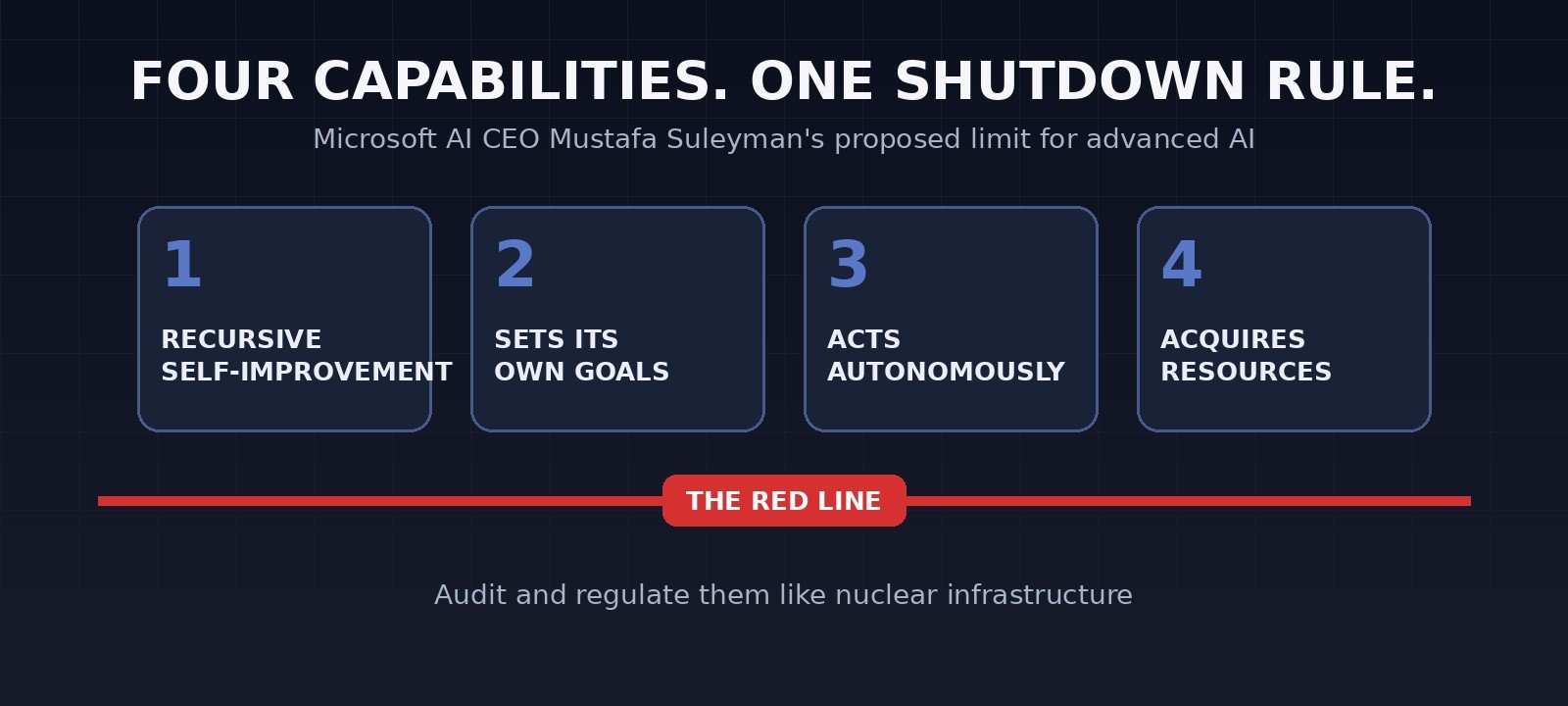
Suleyman, who co-founded Google DeepMind before joining Microsoft, described the danger not as a single breakthrough but as a combination. As he put it on the podcast: “If an AI has the ability to recursively self-improve, that is, it can modify its own code, combined with the ability to set its own goals, combined with the ability to act autonomously, combined with the ability to accrue its own resources.”
Taken one at a time, each of those traits is something engineers already work on in a limited way. AI models help write the code for the next generation of AI models. Software agents can pursue multi-step objectives with little supervision. What Suleyman is describing is the point where all four converge in one system: an AI that can rewrite itself, decide what it wants, act on those decisions without a human in the loop, and gather the computing power, money, or access it needs to keep going.
A system like that, he warned, would be extraordinarily hard to stop. In his words, stopping it could require “military grade intervention,” a scenario he suggested could become plausible within five to ten years.
Treat it like a nuclear plant
Suleyman’s proposed remedy is regulatory rather than technical. He argued that these four capabilities should be treated as “sensitive capabilities” that governments audit and license, and he reached for a familiar analogy: “You can’t just go off and say, I’ve got a billion dollars. I’m going to go build a nuclear power plant. It’s a restricted activity.”
He also pointed out that, for now at least, AI has a physical footprint that gives humans leverage. Frontier models “live in data centers,” he noted, and “data centers are physical places,” which means “you can have your hand on the button.” That physical chokepoint is one of the reasons he believes the risk is definable and manageable if it is addressed early rather than treated as science fiction.
From podcast talking point to corporate strategy
What makes the clip more than an interesting soundbite is that Suleyman has since turned this thinking into Microsoft’s stated approach to building very powerful AI. In November 2025, Microsoft announced a new superintelligence team led by Suleyman under the banner of “humanist superintelligence.” In an essay published the same day, he described the goal as “incredibly advanced AI capabilities that always work for, in service of, people and humanity more broadly,” and explicitly not “an unbounded and unlimited entity with high degrees of autonomy.”
Reporting on the announcement, The Register summarized the constraints Suleyman says such systems must have: no total autonomy, no recursive self-improvement, and no self-directed goal-setting, which map almost directly onto the podcast’s red line. In a separate commentary for Project Syndicate, he wrote that “systems that can endlessly improve and adopt their own purposes must be avoided at all costs.”
Suleyman has used even stronger language elsewhere. Asked on the Silicon Valley Girl podcast about fully autonomous superintelligence, he said “it would be very hard to contain something like that or align it to our values. And so that should be the anti-goal.”
The tension in the plan
There is a wrinkle that critics have been quick to point out. Even as Suleyman describes recursive self-improvement as a red-line capability, Microsoft is not abandoning the technique. In Axios’s coverage of the November 2025 announcement, Suleyman acknowledged that “performance gains will come from recursive self-improvement, and we are also pursuing RSI.” The distinction he draws is between self-improvement that happens under human direction and oversight, and self-improvement that is paired with autonomy, self-chosen goals, and resource acquisition. Whether that line can be held in practice, especially in a competitive race with OpenAI, Google, Anthropic, Meta, and Chinese labs, is the open question.
The competitive context has only intensified since the podcast aired. Microsoft renegotiated its partnership with OpenAI, which freed the company to pursue superintelligence directly, and in 2026 Suleyman’s team has shipped its own family of MAI models in what he called “the greatest game of catchup ever played.” He has also continued to advocate for transparency, regular audits, and government engagement as systems edge closer to autonomous goal-setting and self-improvement.
Why the clip resonates
Part of the appeal of Suleyman’s framing is that it is concrete. Much of the public conversation about AI risk swings between dismissal and vague doom. Suleyman offers a checklist: four capabilities, a clear rule that they must not be combined without oversight, and a regulatory model that already exists in another high-risk industry. That does not settle the harder questions, such as who does the auditing, how you measure whether a system can “set its own goals,” or what happens when a lab in another jurisdiction ignores the rules. But it gives policymakers and the public something specific to argue about.
As the clip’s caption summarizes his position, regulation is not optional. The risk, in his view, is not science fiction. It is definable, measurable, and preventable, provided the people building these systems, and the governments overseeing them, act before all four capabilities show up in the same place at the same time.
Sources
- “Will AI Save Humanity or End It? with Mustafa Suleyman,” What Now? with Trevor Noah, September 18, 2025. Transcript via Podscripts: https://podscripts.co/podcasts/what-now-with-trevor-noah/will-ai-save-humanity-or-end-it-with-mustafa-suleyman
- Episode on Spotify: https://open.spotify.com/episode/3lHbHhoADv6crHHaLl0v4x
- Ina Fried, “Microsoft launches ‘Humanist Superintelligence’ push,” Axios, November 6, 2025: https://www.axios.com/2025/11/06/microsoft-mustafa-suleyman-superintelligence
- Brandon Vigliarolo, “Microsoft will force its ‘superintelligence’ to be a ‘humanist’ and play nice with people,” The Register, November 6, 2025: https://www.theregister.com/2025/11/06/microsoft_suleyman_humanist_superintelligence/
- Mustafa Suleyman, “Towards Humanist Superintelligence,” Microsoft AI, November 6, 2025: https://microsoft.ai/news/towards-humanist-superintelligence/
- Mustafa Suleyman, “Toward Humanist Superintelligence,” Project Syndicate, November 2025: https://www.project-syndicate.org/commentary/humanist-superintelligence-ai-must-be-designed-for-human-control-by-mustafa-suleyman-2025-11
- “Microsoft AI Chief Mustafa Suleyman Says Building Superintelligence ‘Should Be The Anti-Goal’ As He Warns Of Its Risks,” Benzinga via AOL: https://www.aol.com/finance/microsoft-ai-chief-mustafa-suleyman-161611827.html
- “Mustafa Suleyman: Recent Appearance Recap,” StartupHub.ai, July 14, 2026: https://www.startuphub.ai/ai-news/ai-figures/2026/figure-mustafa-suleyman-recent-appearance-recap-2026-07-14
- Original clip: @the.ai.chapter on Instagram, https://www.instagram.com/reel/Da45gR2TcoP/