A clip from the All-In podcast has been circulating on Instagram with a provocative headline: open-source AI could hand China “the entire global economy.” The speaker is David Friedberg, CEO of The Production Board and one of the show’s four hosts, and his argument is worth unpacking, both because it is more subtle than the headline suggests and because it lands in the middle of a live policy fight in Washington over whether Americans should be allowed to use Chinese AI models at all.
What Friedberg actually said
The clip comes from an All-In episode released in late July 2026 titled “The Fight Over Open Source AI, Anthropic’s $1.5B Payout, NYC Socialists: Evictions = Violence?” The segment was prompted by the release of Kimi K3, a 2.8-trillion-parameter model from China’s Moonshot AI that VentureBeat described as the largest open-source model ever released, with benchmark scores that rival top American systems at a fraction of the price.
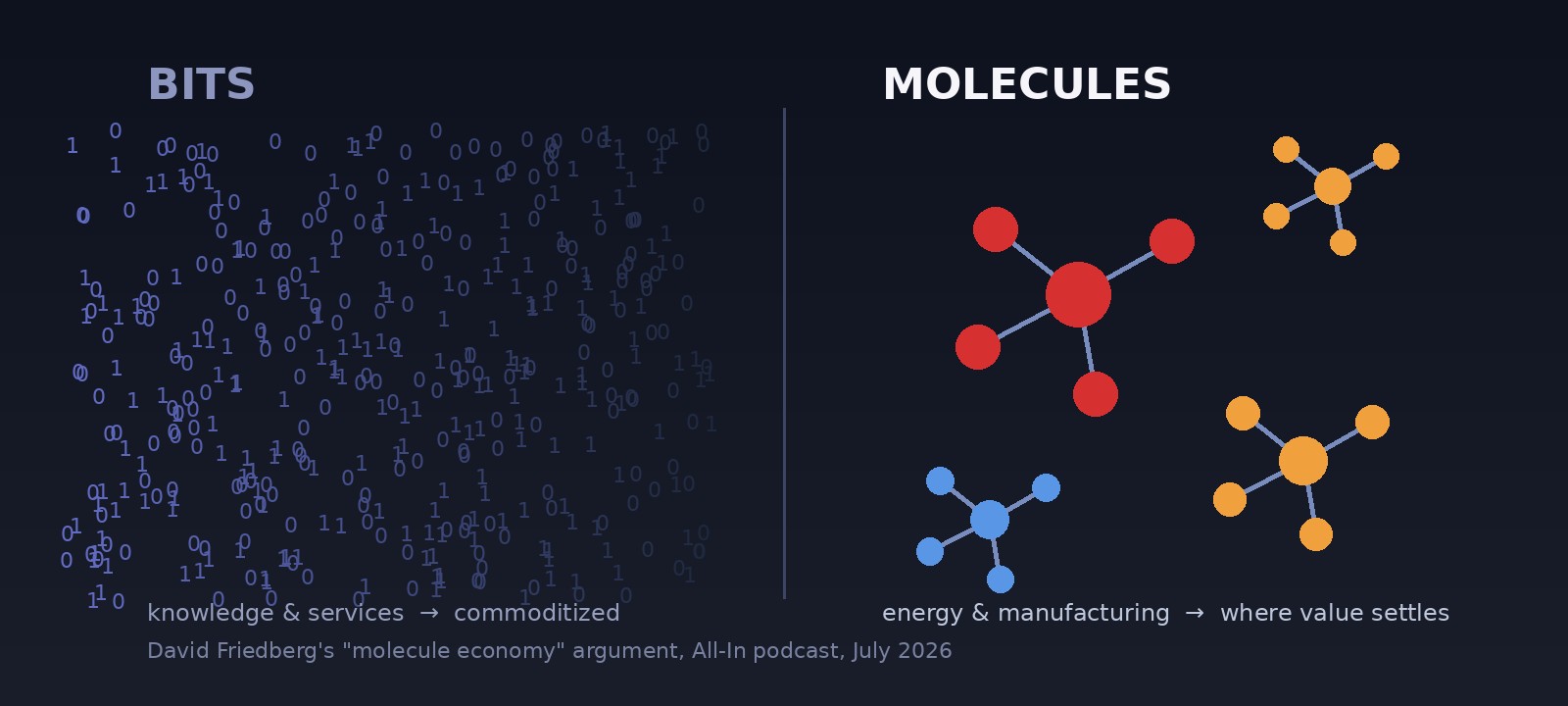
Friedberg’s argument runs like this. For decades, the United States and the West have derived most of their economic value from the knowledge economy and the services economy: software, finance, media, consulting, law, design, and the like. Artificial intelligence, and open-source AI in particular, compresses that value. When a capable model is free to download and cheap to run, the work of producing and moving information stops commanding a premium. In his words, “the knowledge economy and the services economy gets compressed, much like AI and open-source AI in particular effectively flattens that value.”
What remains, he argues, is what he calls the “molecule economy”: the ability to convert raw materials into physical goods, and the energy required to do it. “Everything in our world is driven by molecule conversion,” he said. And on that front, he contends, the comparison is stark: “We have 1 terawatt of electricity production capacity in the US, and they’re on their way to having 8. We have about 10 billion square feet of manufacturing capacity. They have 200 billion square feet.”
The conclusion follows directly. If China commoditizes the knowledge layer by giving away frontier-class models, “they are left holding all the value in the global economy because they can make stuff and they can make it cheaper than anyone.”
Checking the numbers
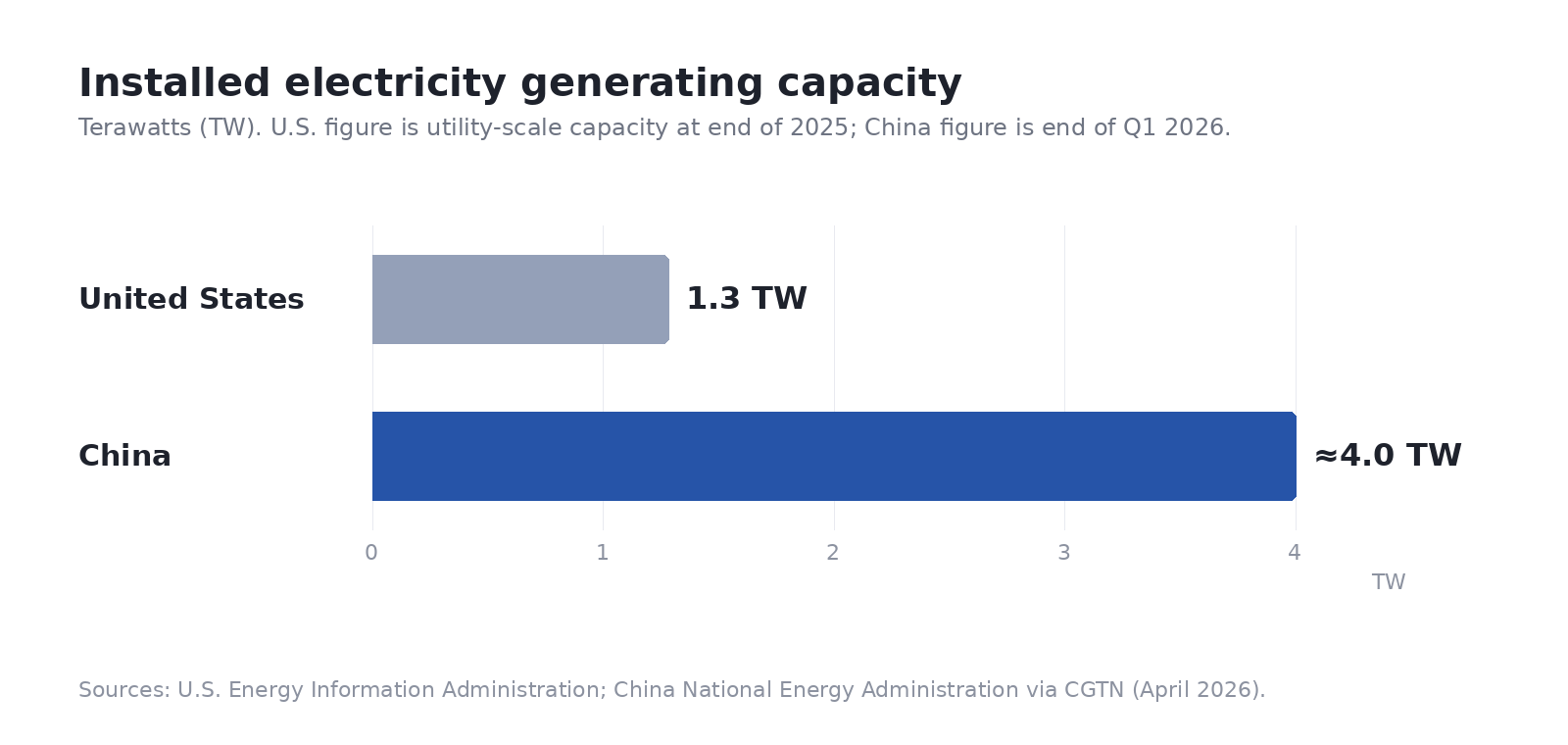
Friedberg’s electricity figures hold up reasonably well, with one caveat. According to the U.S. Energy Information Administration, the United States ended 2025 with about 1,281 gigawatts of utility-scale generating capacity, or roughly 1.3 terawatts, and about 1.34 terawatts when small-scale rooftop solar is included. China’s National Energy Administration, as reported by CGTN, put China’s installed capacity at nearly 4 billion kilowatts, or 4 terawatts, at the end of the first quarter of 2026, roughly three times the American total and nearly 30 percent of global capacity. China went from 3 to 4 terawatts in about two years, and in 2025 alone it added roughly 540 gigawatts, compared with about 63 gigawatts of projected utility-scale additions in the United States. The “8 terawatts” Friedberg cites is a forward projection rather than a present-day figure, but at China’s current pace of growth it is not an outlandish one.
The manufacturing square-footage comparison is harder to verify, and we could not find an authoritative source for either the 10-billion or 200-billion figure. A better-documented proxy points in the same direction, though. A 2024 report from the United Nations Industrial Development Organization, summarized by the Information Technology and Innovation Foundation, projects that China’s share of global manufacturing output will reach 45 percent by 2030 while the U.S. share falls to 11 percent. Whether the ratio is 20 to 1 or something smaller, the underlying point that China’s physical production base dwarfs America’s is well supported.
Is China giving away models on purpose?
Friedberg is not the only person to suggest that China’s open-source strategy is a deliberate play to shift value away from software and toward hardware and energy. A March 2026 staff paper from the U.S.-China Economic and Security Review Commission, titled “Two Loops,” argues that China’s open AI strategy creates two reinforcing feedback loops: a digital loop, in which freely available models spread globally and are improved by the community, and a physical loop, in which deploying AI across manufacturing, logistics, and robotics generates proprietary operational data that feeds back into better models. The paper notes that Chinese models overtook American models in total downloads on Hugging Face in August 2025 and that Alibaba’s Qwen family alone has spawned more than 100,000 derivatives. Its most pointed conclusion is that “if the models that matter most for industrial AI are small, specialized, and open, the current U.S. policy framework could be targeting the wrong layer of the competition.”
An August 2026 discussion document from India’s Takshashila Institution lays out five motivations for China’s open-weight releases: lower training costs, geopolitical prestige, commoditizing American competitors, absorbing state-directed capital, and what the authors call the infrastructure play. On that last point they quote Alibaba chairman Joe Tsai: “Open source drives demand for AI and future inference needs benefiting full-stack providers.” That is essentially Friedberg’s thesis stated from the Chinese side of the table. Notably, the Takshashila authors also identify thresholds, such as ecosystem lock-in and commoditization saturation, that could lead China to restrict its openness later in the decade.
The policy fight in the background
The reason this conversation is happening now is that a serious proposal to restrict Chinese open-source models is on the table. According to the episode summary, the debate was sharpened by reports that Anthropic had begun characterizing Chinese “distillation,” the practice of training a model on another model’s outputs, as intellectual property theft, even as it defends its own training on public web content as fair use.
All four All-In hosts opposed a ban, but for different reasons. David Sacks argued that if stopping distillation were the real goal, the right move would be to block Chinese access to American models at the source rather than to punish American developers who want to use cheaper alternatives. Chamath Palihapitiya framed the situation as commoditization happening at unprecedented speed and warned that government intervention to protect frontier-lab margins “will tank the stock market.” Jason Calacanis pointed to startups that have already migrated most of their workloads to open models at savings of 50 to 90 percent. Friedberg’s contribution was the geopolitical frame: if open models are inevitable, the question is not whether the knowledge economy gets compressed but who ends up holding the physical assets when it does.
Where the argument is strongest and weakest
The strongest part of Friedberg’s case is the energy math. Building electricity generation capacity is slow, capital-intensive, and politically contested in the United States, and the gap with China is widening rather than narrowing. If AI really does make intelligence cheap and abundant, then the binding constraint on economic output shifts toward power, materials, and manufacturing, and those are areas where China has invested for decades.
The weaker part is the implied inevitability. The same USCC and Takshashila analyses that support his framing also point out that the United States leads decisively at the frontier, that American AI capital expenditure in 2025 exceeded $350 billion compared with less than $40 billion in China, and that China’s openness may be a phase rather than a permanent strategy. American manufacturing and energy policy are also not fixed. Friedberg himself has been a vocal advocate for a rapid build-out of U.S. generation capacity, and in that sense his warning is less a prediction than an argument for what the country should do next.
Either way, the framing is a useful one for anyone trying to understand why the open-source AI debate has become so heated. The fight is not really about model weights. It is about what becomes scarce, and therefore valuable, once intelligence is no longer scarce at all.
Sources
- “The Fight Over Open Source AI, Anthropic’s $1.5B Payout, NYC Socialists: Evictions = Violence?” All-In with Chamath, Jason, Sacks & Friedberg, July 2026. Transcript via HappyScribe: https://podcasts.happyscribe.com/all-in-with-chamath-jason-sacks-friedberg/the-fight-over-open-source-ai-anthropic-s-1
- Episode summary, BigGo Finance: https://finance.biggo.com/podcast/827b5e2af3019978
- Wilson Wang, “Dr Wil’s Ruminations – July 26, 2026 All-In Podcast,” Substack: https://drwilsonwang.substack.com/p/dr-wils-ruminations-july-26-2026
- Michael Nuñez, “China’s Moonshot AI releases Kimi K3, the largest open-source model ever, rivaling top U.S. systems,” VentureBeat, July 16, 2026: https://venturebeat.com/technology/chinas-moonshot-ai-releases-kimi-k3-the-largest-open-source-model-ever-rivaling-top-u-s-systems
- Ngor Luong, “Two Loops: How China’s Open AI Strategy Reinforces Its Industrial Dominance,” U.S.-China Economic and Security Review Commission, March 23, 2026: https://www.uscc.gov/sites/default/files/2026-03/Two_Loops–How_Chinas_Open_AI_Strategy_Reinforces_Its_Industrial_Dominance.pdf
- Pranay Kotasthane, Nitin Pai, and Bharath Reddy, “Why Is China Giving Away Its AI Models?” Takshashila Institution, August 7, 2026: https://takshashila.org.in/content/publications/20260807-why-is-china-giving-away-its-ai-models.html
- “Electricity generation, capacity, and sales in the United States,” U.S. Energy Information Administration: https://www.eia.gov/energyexplained/electricity/electricity-in-the-us-generation-capacity-and-sales.php
- “China’s total installed power capacity nears 4 billion kW in Q1 2026,” CGTN, April 20, 2026: https://news.cgtn.com/news/2026-04-20/China-s-total-installed-power-capacity-nears-4-billion-kW-in-Q1-2026-1Mv6wRFRpLO/p.html
- “China Adds Power 8x More Than the US in 2025,” CarbonCredits.com, February 4, 2026: https://carboncredits.com/china-adds-power-7x-more-than-the-us-in-2025-with-500b-energy-build-out-in-a-single-year/
- “A New Study Finds the US Share of Global Manufacturing Will Fall to 11 Percent by 2030,” ITIF, February 18, 2025: https://itif.org/publications/2025/02/18/new-study-finds-us-share-of-global-manufacturing-fall-to-11-percent-by-2030/
- The All-In Podcast on X, Friedberg on U.S. electricity capacity, episode 229: https://x.com/theallinpod/status/1926337469722554749
- Original clip: @techno.optimist.prime on Instagram, https://www.instagram.com/reel/DcwF4ykt4gr/