A short clip of mathematician and former Harvard physicist Eric Weinstein has been circulating on Instagram with a blunt message for anyone planning a career: the wave is coming, and nothing your parents or teachers experienced will prepare you for it. The clip is drawn from Weinstein’s July 2025 appearance on “The Diary of a CEO” with Steven Bartlett, and while the episode wandered across many subjects, its section on artificial intelligence and the future of work has proven to have the longest shelf life. A year on, new labor market data makes it worth revisiting what he said and how well it is holding up.
The tsunami metaphor
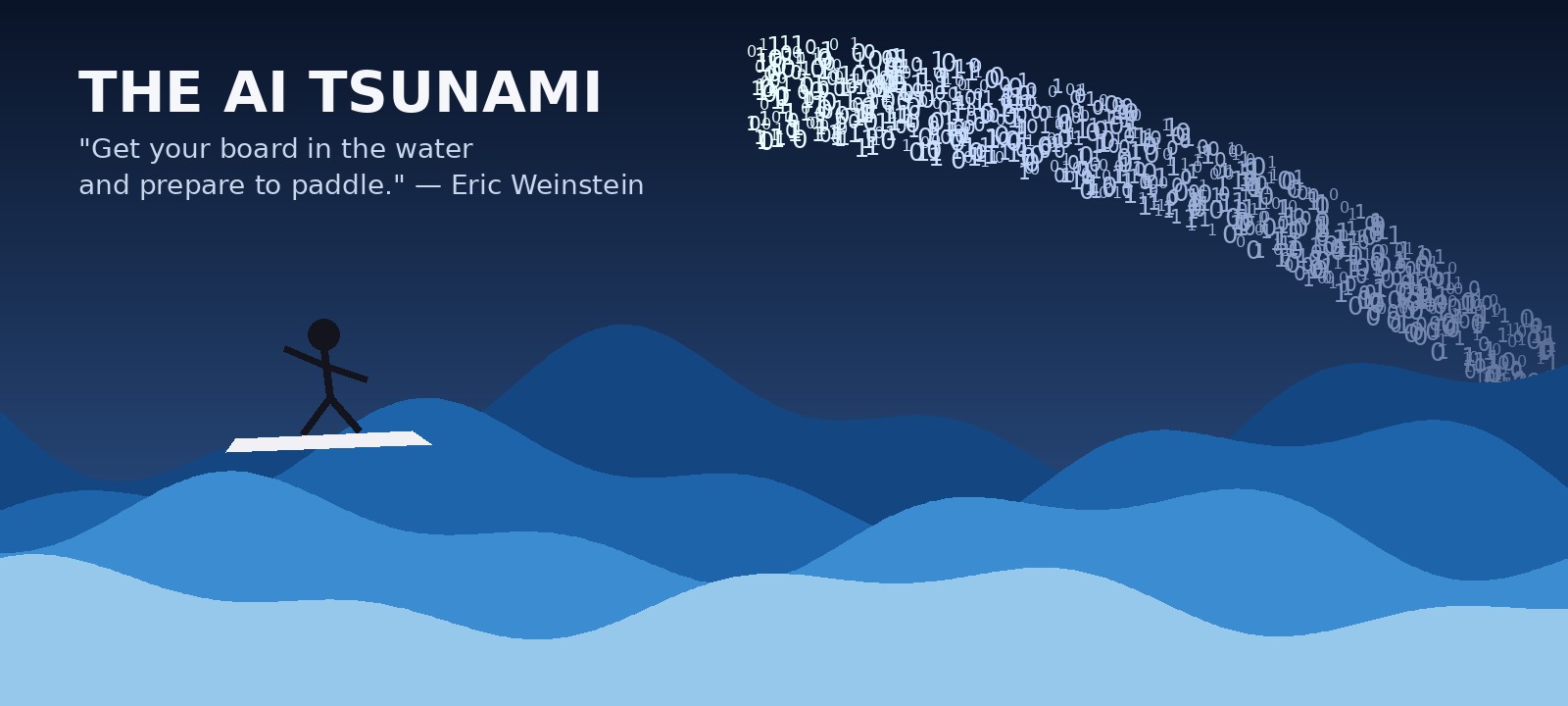
Weinstein’s central claim is not that AI is dangerous in some abstract, science-fiction way. It is that the pace of change is about to outrun the ability of institutions, and individuals, to adjust. “The tsunami of a lifetime is coming,” he told Bartlett, “and nothing your elders have seen is going to prepare” you for it.
He was unusually specific about what that means for traditional career planning. “Every occupation that is named is over,” he said. “I’m going to be a dentist, radiologist, accountant, teacher. These are all over.” The point is not that dentists and teachers will vanish overnight. It is that the idea of choosing a fixed label at 18 and riding it for four decades is the thing that no longer works, because large language models and narrow AI systems are already absorbing the repetitive intellectual tasks that used to make up much of those jobs. Weinstein pointed to radiology and chess as fields where pattern-recognition automation has already changed the work, and he cited the 2017 “Attention Is All You Need” paper, which introduced the transformer architecture behind modern AI, as an example of how quickly a single scientific advance can reshape entire industries.
Notably, he argued that the public obsession with a hypothetical future artificial general intelligence distracts from disruptions that are already here. The real story, in his telling, is not a superintelligence in 2040 but the ordinary automation of cognitive work in 2025.
His advice: flexibility over specialization
Weinstein’s prescription is short. “Get flexible, get good,” he said. “Get good on a bunch of different stuff. Learn how to think across disciplines.” And for young people staring at the wave: “Get your board in the water and prepare to paddle. Like all get out.”
The surfing image is doing real work. You cannot stop a tsunami, and you cannot outrun it. What you can do is be in the water already, with a board, when it arrives. Translated out of metaphor, that means building competence in several areas rather than one, cultivating the ability to move between fields, and treating learning as a permanent condition rather than something that ends with a diploma. He also urged listeners to find meaning in relationships and daily life rather than in job titles, an acknowledgment that identity built entirely on an occupation is fragile in a world where occupations are being redefined.
What the data says a year later
Weinstein was speaking from intuition and from his vantage point as a technologist. The evidence that has accumulated since then is more mixed than his rhetoric, but it points in the same direction on the question that matters most: adaptability.
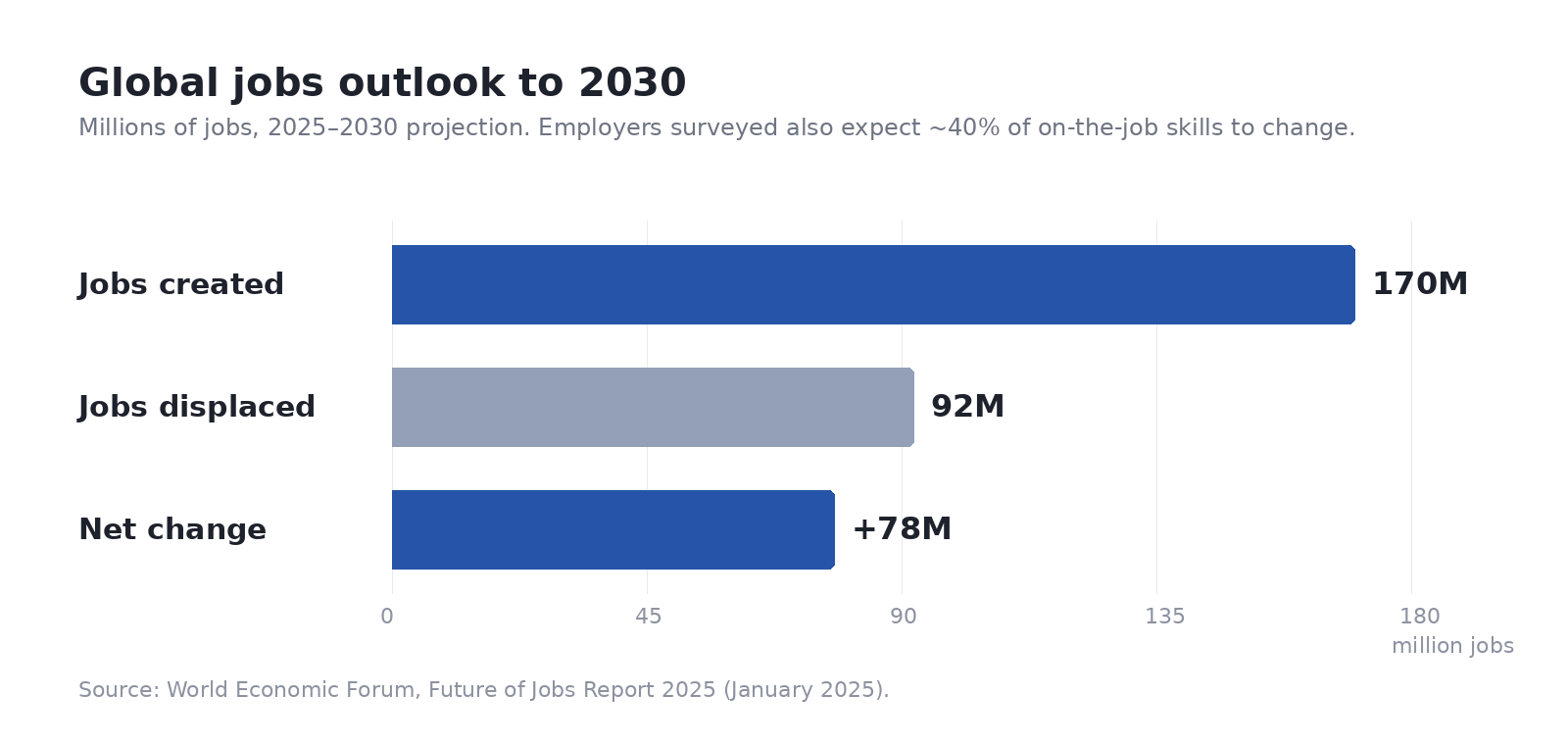
The World Economic Forum’s “Future of Jobs Report 2025,” published in January 2025, projected that by 2030, 170 million new jobs will be created and 92 million displaced, a net gain of 78 million. That is not a picture of mass unemployment. But the same report estimated that nearly 40 percent of the skills required on the job will change by 2030, that 59 of every 100 workers will need reskilling or upskilling, and that 63 percent of employers already cite skills gaps as their biggest barrier. The jobs may survive; the skills inside them will not.
PwC’s 2026 Global AI Jobs Barometer, released in June 2026, found that AI is splitting the labor market into two paths. In what PwC calls “professionalised” roles, such as radiologists and recruiters, AI takes over routine tasks and elevates human judgment; those roles are seeing twice the job growth and 42 percent faster wage increases. Workers with AI skills now command a 62 percent wage premium on average. Perhaps the most striking finding is that entry-level roles most exposed to AI are seven times more likely to require what used to be senior-level competencies: leadership, creativity, judgment, and face-to-face interaction. As PwC’s Pete Brown put it, “AI is removing some of the routine work that once acted as an apprenticeship.”
That last point is where the more worrying evidence lives. Research led by Stanford economist Erik Brynjolfsson, reported in August 2026, found that employment for workers aged 22 to 25 in occupations where AI is used to automate rather than augment work has been declining sharply, while more experienced workers in the same fields are largely unaffected. Brynjolfsson warned of “a labor market that keeps its overall employment level while quietly closing the on-ramp for people starting their careers.” Anthropic’s own labor market research, published in March 2026, found a similar pattern in milder form: overall unemployment effects “indistinguishable from zero,” but a roughly 14 percent relative decline in the rate at which young workers enter the most exposed occupations.
Where Weinstein is right, and where the picture is more complicated
Taken together, the data supports Weinstein’s core thesis while softening his most sweeping line. Occupations are not “over,” at least not yet; overall employment in AI-exposed fields has held up, and in many cases grown. What is over is the apprenticeship model that let a new graduate learn a profession by doing its routine work for a few years. If the on-ramp is narrowing, the people who get through will be the ones who arrive already able to exercise judgment, work across disciplines, and pick up new tools quickly. That is exactly the profile Weinstein described.
The tsunami metaphor also captures something the aggregate statistics obscure. A net gain of 78 million jobs worldwide is cold comfort to a 24-year-old accounting graduate whose entry-level role has been automated. Averages describe the ocean; individuals experience the wave.
Where Weinstein’s framing is weaker is in what it leaves out. Adaptability is necessary but not sufficient. The WEF report found that 11 of every 100 workers are unlikely to receive any training at all, which means more than 120 million people face medium-term redundancy risk through no lack of willingness to adapt. Individual flexibility cannot substitute for employers, schools, and governments rebuilding the on-ramps that AI is removing. Weinstein’s advice is the right advice for a person. It is not, on its own, a policy.
The takeaway
The clip resonates because it names something many people feel but cannot articulate: the sense that the rules of career-building have changed faster than the institutions that teach them. Weinstein’s answer is not to panic and not to wait. It is to become the kind of person who can learn anything, to build skills in more than one domain, and to stop expecting a single job title to carry you through a working life. A year of data suggests that is good advice. It also suggests that the people who most need it are the ones just starting out, and that the rest of us have work to do to keep the water open for them.
Sources
- “Eric Weinstein (Ex-Harvard Physicist): The Collapse Has Already Started!” The Diary of a CEO with Steven Bartlett, July 14, 2025. Transcript via The Singju Post: https://singjupost.com/eric-weinstein-jeffrey-epstein-was-a-front-transcript/
- Episode summary, Podmarized: https://podmarized.com/episodes/the-diary-of-a-ceo/eric-weinstein-jeffrey-epstein-was-a-front-the-collapse-has-already-started
- Episode on Spotify: https://open.spotify.com/episode/43B49SpfDkHKtpsxq1h5e2
- “Future of Jobs Report 2025: 78 Million New Job Opportunities by 2030 but Urgent Upskilling Needed to Prepare Workforces,” World Economic Forum, January 8, 2025: https://www.weforum.org/press/2025/01/future-of-jobs-report-2025-78-million-new-job-opportunities-by-2030-but-urgent-upskilling-needed-to-prepare-workforces/
- “AI reshapes global labour market into two distinct paths, rewarding human skills: PwC 2026 Global AI Jobs Barometer,” PwC, June 15, 2026: https://www.pwc.com/gx/en/news-room/press-releases/2026/pwc-2026-ai-jobs-barometer.html
- “AI is hitting entry-level jobs hardest, Stanford study finds,” Business Story, August 24, 2026: https://www.businessstory.org/2026/08/24/ai-is-hitting-entry-level-jobs-hardest-stanford-study-finds/
- “Labor market impacts of AI: A new measure and early evidence,” Anthropic, March 5, 2026: https://www.anthropic.com/research/labor-market-impacts
- Original clip: @unthinkableai on Instagram, https://www.instagram.com/reel/Db0yIJlSfJl/